[Design pattern]: 设计模式相关系列
介绍
概念: 将一个请求封装为一个对象,从而使你可用不同的请求对客户进行参数化;对请求排队或记录请求日志,以及支持可撤消的操作。
应用场景: 统一处理器的入口,由一个公共的入口来执行各种各样的请求
好处: 扩展方便,入口统一
CODE
处理器的接口定义
1
2
3
4
5
6
7
| package note.com.Command;
public interface ICommand {
public void doICommand(String label);
}
|
定义各种情况的处理实现
1
2
3
4
5
6
7
8
9
10
11
12
13
14
| package note.com.Command;
public class AnimalCommand implements ICommand{
public void doICommand(String label) {
System.out.println(label+":由我动物类处理器处理");
}
}
|
1
2
3
4
5
6
7
8
9
10
11
12
13
14
| package note.com.Command;
public class FishCommand implements ICommand{
public void doICommand(String label) {
System.out.println(label+":由我鱼类处理器处理");
}
}
|
1
2
3
4
5
6
7
8
9
10
11
12
13
| package note.com.Command;
public class InsectCommand implements ICommand{
public void doICommand(String label) {
System.out.println(label+":由我昆虫处理器处理");
}
}
|
1
2
3
4
5
6
7
8
9
10
11
12
13
| package note.com.Command;
public class PersonCommand implements ICommand{
public void doICommand(String label) {
System.out.println(label+":由我人类处理器处理");
}
}
|
1
2
3
4
5
6
7
8
9
10
11
12
13
| package note.com.command;
public class FirstCommand implements ICommand{
public void doICommand(String label) {
System.out.println(label+":由我first处理器处理");
}
}
|
实现一个控制处理器的分配类
1
2
3
4
5
6
7
8
9
10
11
12
13
14
15
16
17
18
19
20
21
22
23
24
25
26
27
28
29
30
31
32
33
34
| package note.com.command;
import java.util.HashMap;
import java.util.Map;
public class MainCommand{
public static final String FISH = "fish";
public static final String ANIMAL = "animal";
public static final String INSECT = "insect";
public static final String PERSON = "person";
public static final String FIRST = "first";
private Map<String,ICommand> Commands = new HashMap<String,ICommand>();
public MainCommand(){
Commands.put(FISH, new FishCommand());
Commands.put(ANIMAL, new AnimalCommand());
Commands.put(INSECT, new InsectCommand());
Commands.put(PERSON, new PersonCommand());
Commands.put(FIRST, new FirstCommand());
}
public void doICommand(String label) {
ICommand ICommand = Commands.get(label);
if(ICommand!=null){
ICommand.doICommand(label);
}
}
}
|
测试类
1
2
3
4
5
6
7
8
9
10
11
12
13
14
15
16
| package note.com.Command;
public class CommandTest {
public static void main(String[] args) {
System.out.println("我这里有一个生物需要处理");
String thing1 = MainCommand.INSECT;
String thing2 = MainCommand.ANIMAL;
new MainCommand().doICommand(thing1);
new MainCommand().doICommand(thing2);
}
}
|
结果
1
2
3
| 我这里有一个生物需要处理
insect:由我昆虫处理器处理
animal:由我动物类处理器处理
|
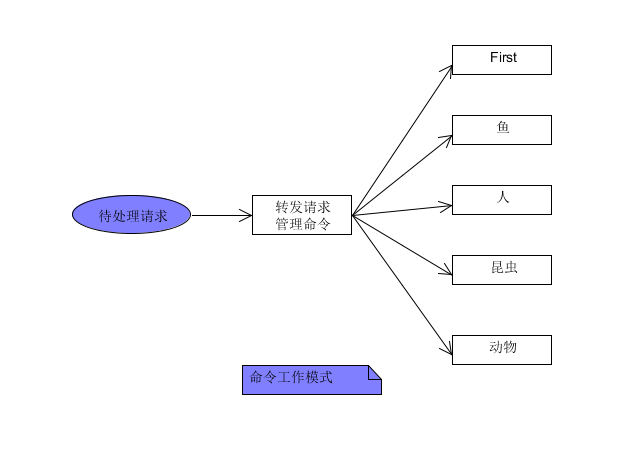
由此,所有的待处理都从MainCommand入口进行处理,不需要知道具体是谁处理了.另外,有新增的物种需要处理时只需要扩张ICommand的实现,并且把该实现收MainCommand管理即可. 例子中没有将实际处理类与MainCommand进行分离,想要这么做也很简单,方式有很多,例如实现配置文件方式加载.
命令模式与职责链模式的区别
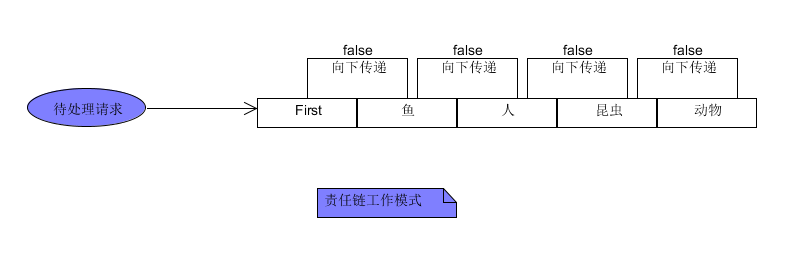
比较前文的职责链例子与本篇中的命令例子,命令模式的所有Command处理类最后由一个第三方的类来管理与分配具体的执行类.而职责链是直接请求到第一个处理类上,依次往下传递,直到有人处理.
####用两张图说明他们的工作方式:
责任链工作模式:
命令模式工作模式: